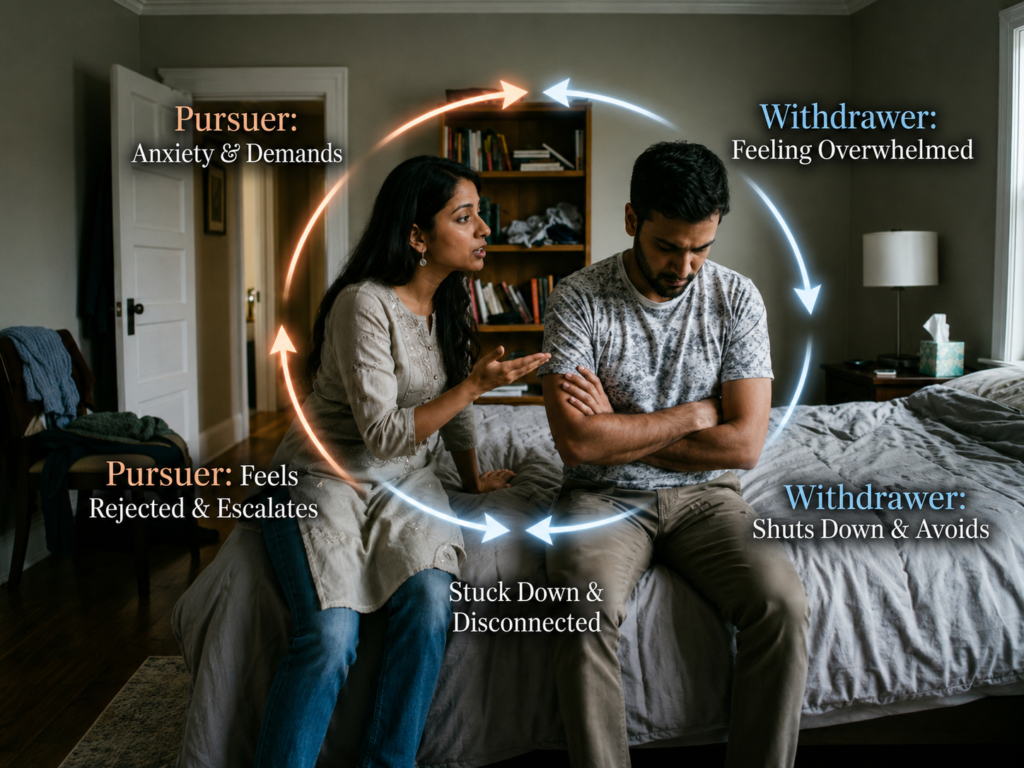
Why Every Conversation Turns into an Argument: Understanding the Pursuer-Withdraw Loop
We have all been there. A simple question about chores, a weekend plan, or household responsibilities suddenly escalates into a screaming match. Or worse, a wall of icy, suffocating silence.If you are navigating a high-stress life, balancing demanding corporate careers, or dealing with the quiet weight of family expectations, you might feel like you are growing further apart every single day. You love each other, but you are exhausted from walking on eggshells. You look at your partner and secretly wonder: “Is this relationship even going to work out?”The problem isn’t a lack of love. It’s an exhausting, invisible loop called the Pursuer-Withdraw Dynamic (clinically known as the Demand-Withdraw cycle). What is the Pursuer-Withdraw Dynamic? This pattern is one of the most destructive yet common relationship loops. It occurs when one partner desperately pushes for connection, answers, or change, while the other partner feels overwhelmed by the intensity and pulls away to protect themselves. To the couple caught inside it, it feels like an endless trap. But if you look beneath the surface, both partners are actually reacting to the exact same thing: the fear of losing the relationship. 1. The Pursuer: “We need to talk right now.” The pursuer feels an intense wave of anxiety when they sense emotional distance. In high-stress households, this is often triggered by unmanaged stress, fatigue, or feeling isolated in managing everyday responsibilities. To fix the distance, they step forward. They ask questions, offer critiques, or raise their voice. To them, they aren’t attacking—they are desperately fighting to save the connection before it slips away. 2. The Withdrawor: “Just leave me alone.” When the pursuer pushes, the withdrawor’s nervous system goes into fight-or-flight mode. They experience the pursuer’s anxiety as a wave of intense criticism or failure. To prevent the fight from escalating and to protect the peace, they withdraw. They quiet down, walk out of the room, or bury themselves in work, their phone, or hobbies. To them, their silence isn’t a lack of care—it is a defensive shield to stop things from getting worse.The Toxic Paradox: The harder the pursuer pushes for a response, the more the withdrawer shuts down to protect themselves. The more the withdrawer shuts down, the more anxious and aggressive the pursuer becomes. The Toxic Paradox: The harder the pursuer pushes for a response, the more the withdrawer shuts down to protect themselves. The more the withdrawer shuts down, the more anxious and aggressive the pursuer becomes. What the Research Says: The Cost of the Silent Loop This isn’t just a theory; it is a heavily documented psychological reality. A comprehensive meta-analysis published in Communication Monographs analyzed data across 74 distinct studies involving more than 14,000 participants. The research established a profound, direct link between the prevalence of the demand-withdraw communication pattern and severe declines in overall relationship satisfaction. The data explicitly showed that couples locked in this cycle suffer from a major loss of emotional intimacy, increased levels of individual anxiety, and elevated physiological stress responses (like spike in cortisol and elevated heart rates) during conflicts. It remains one of the single greatest structural predictors of relational dissolution. Actionable Tools to Break the Cycle If you recognize your marriage or relationship in this pattern, take a deep breath. Your relationship isn’t broken beyond repair—it is simply stuck in a bad system. Here is how you can begin shifting the dynamic today: For the Pursuer: Practice the “Softened Startup” Before approaching your partner, lower your physical stress levels. Instead of starting with a finger-pointing accusation (“You never listen to me“), start with a vulnerable “I” statement (“I am feeling incredibly overwhelmed right now, and I really need your support to figure this out“). Give your partner space to respond without treating their pause as an immediate rejection. For the Withdrawor: Give a “Time-Out” with a Return Policy It is completely okay to feel overwhelmed and need space. However, storming out or shutting down without a word triggers your partner’s deepest fears of abandonment. Instead, try saying: “I want to hear you, but my mind is flooding right now and I can’t process this well. I need 20 minutes to calm down, and then I promise I will come back so we can finish talking.” Crucial step: You must be the one to initiate coming back once the time is up. Frequently Asked Questions Does the pursuer-withdraw dynamic mean we have fallen out of love? Absolutely not. In fact, it means the exact opposite. This dynamic only exists because both of you care deeply about the relationship but are using conflicting survival mechanisms to protect it. The pursuer fights for it by leaning in; the withdrawer protects it by stepping back. Couples counseling helps align your strategies so you are fighting the problem, not each other. How many sessions does it take to fix a repeated cycle of arguments? Every couple’s timeline is completely unique. However, most couples begin to recognize their specific triggers and learn how to de-escalate the demand-withdraw loop within 4 to 6 sessions. True behavioral change and rebuilding deep intimacy typically take a few months of consistent, dedicated practice. What if my partner refuses to come to couples counseling? This is incredibly common. If your partner is hesitant, you can always begin with individual sessions. When you change how you react and show up within the relationship loop, the entire dynamic is forced to shift. Often, when the more hesitant partner sees positive changes, they become much more open to joining later on.
Why Every Conversation Turns into an Argument: Understanding the Pursuer-Withdraw Loop Read More »